

Painting Veolia Environnement Trimaran
This large painting (inspired by a photograph by sports photographer, Alex Irwin) was painted over a number of months using professional New Masters Classic Acrylic paints by Old Holland — a company that has its origins with the Dutch Masters going back to the 17th Century. Old Holland are renowned for the purity and quality of their high-grade pigments.

Rolex Fastnet Race Art
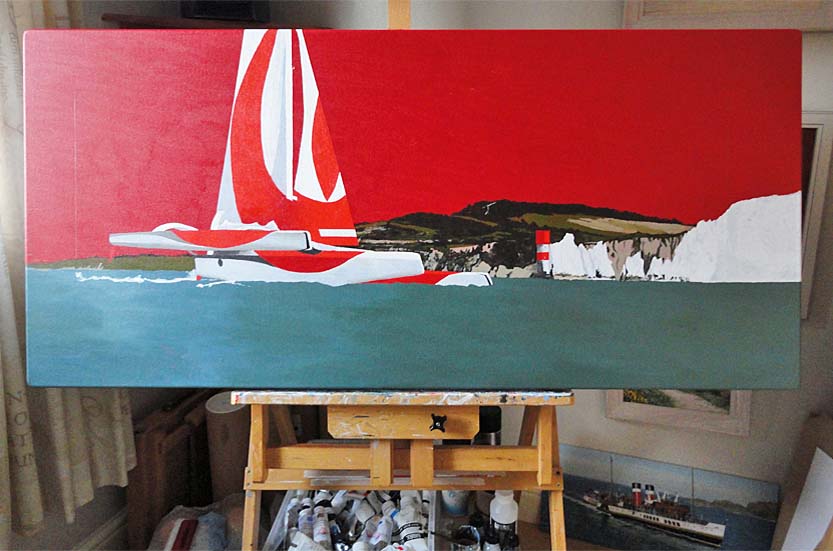
When I first set out to paint the racing trimaran off the Needles, Isle of Wight, I knew the real challenge wasn't just in capturing the sleek lines of the boat, but in conveying the restless energy of the sea itself. Waves are never still — they breathe, shift, and catch the light in fleeting ways. My goal was to capture that living rhythm in acrylics, so the water wouldn't just be a backdrop, but a force that carried the story of the painting, as you will see in the work-in-progress images featured on this blog post.
Painting the Trimaran
I began, as I sometimes do, with a red coloured ground (a red paint layer) for the sky. Reds are known as 'warm' colours in the world of art; so having a warm layer beneath the 'cool' blues of the sky, would mean that some of that red would show through in a very subtle way and still give some warmth to the sky. These tiny areas of red would make the sky interesting because the red might be noticed by the viewer. Red, being one of the most powerful colours in art, second to yellow, is perceived by the brain noticeably sooner than other colours (this is the reason it is used in road warning signs and signalling); and artists over the centuries have used variations of red in their paintings to strategically and purposely draw the eye of the viewer to the main area of interest in the composition.
Once the red ground was applied, I painted a base layer for the water. This first wash of colour set the mood and gave me a surface I could build depth upon. Once it dried, I carefully marked out a grid of one-inch squares in pencil. This 'squaring up' method might sound a bit methodical, but it gave me a reliable guide as I worked across the canvas from left to right. It kept the proportions of the wave patterns consistent while still allowing me the freedom to interpret the sea's movement.

For the water itself, I turned to a limited palette that I've found beautifully versatile. This painting was produced by brushwork alone; I do not use palette knives to apply paint on my paintings. I used Old Holland's New Masters Classic Acrylics Payne's Grey to give me a deep, moody foundation, while Olive Green brought a subtle warmth to the shadows of the swell. To these, I added Liquitex Professional Heavy Body Acrylic Phthalocyanine Blue (Green Shade), which gave the sea its sharp, cleaner tone. Layer by layer, these colours began to echo the weight and translucence of real water.
The third layer was where the sea truly started to come alive. By mixing in Schmincke PRIMAcryl Finest Artist Acrylic Titanium White (a very good opaque acrylic white paint), I lightened sections of the water just enough to create mid-tones and gentle highlights. This part required patience and restraint. It's always tempting to go too bright too quickly, but the balance between dark depth and luminous crest is delicate. I wanted contrast, yes, but not at the expense of subtlety. So I slowed down, carefully adjusting until the water began to come together with believable movement.
For the wave foam, I went directly to pure Titanium White. To capture the spray, I reached for one of my favourite unconventional tools: a toothbrush. By running my thumb along the bristles, I was able to flick fine specks of paint across the canvas, placing them where they would be most effective in the scene. This simple technique gave added realism to the waves and their sense of energy and spontaneity.

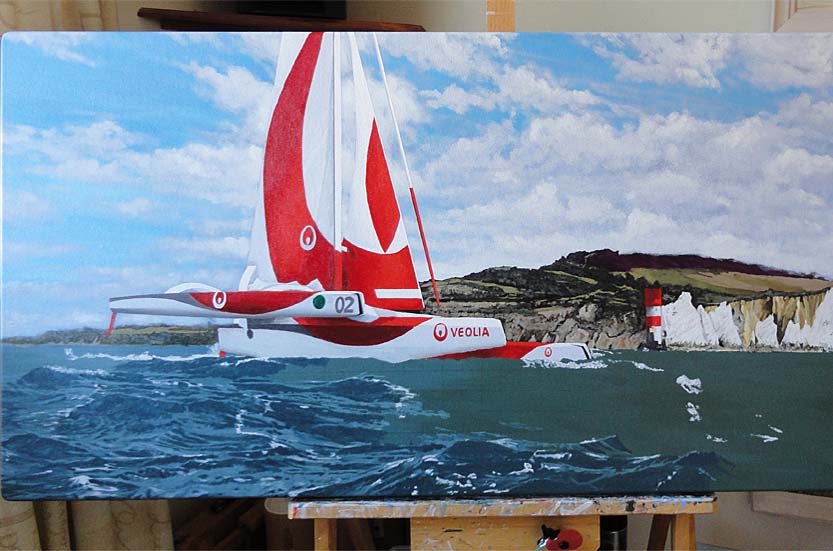


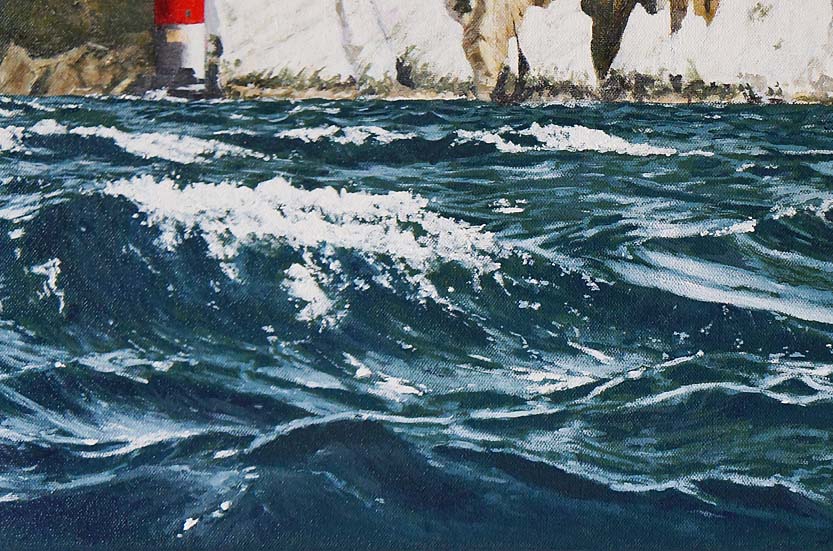

In the end, painting this seascape felt like collaborating with the elements themselves. Every layer, from the darkest underpaint to the final spray of foam, was about listening closely to the sea and translating its rhythm onto canvas. The trimaran races through the scene, yes, but it's the water that tells you just how exhilarating that journey must have been; and a key part to painting is to learn how to translate energy and motion with paint.


Discover more about this painting
I hope you enjoyed this insight into the painting of Veolia Environnement Trimaran. Thank you for reading. Discover more about this painting and about the technical aspects and history of this trimaran...
Frequently Asked Questions
What is the painting of the Veolia Environnement Trimaran about?
The painting depicts the MOD 70 multihull racing trimaran 'Veolia Environnement', capturing its speed, design, and connection to modern maritime racing. It is a fine example of contemporary marine art, blending technical detail with artistic storytelling.
Why is this painting considered contemporary marine art?
This work is considered contemporary marine art because it portrays a modern sailing vessel using a traditional fine art approach. It highlights both the aesthetics and historical importance of recent maritime racing, placing it within the ongoing tradition of British seascape painting.
Who painted the Veolia Environnement Trimaran?
The painting was created by British marine artist Mark Woollacott, known for his detailed and expressive works depicting the sea, ships, and maritime history.
Is the Veolia Environnement Trimaran linked to the Rolex Fastnet Race?
Yes, the Veolia Environnement MOD 70 racing trimaran has strong connections to the Rolex Fastnet Race, one of the world's most renowned offshore yacht races. The painting commemorates this connection, celebrating both sporting achievement and maritime heritage.
Why is this painting significant in British marine art?
It represents a bridge between Britain's long maritime tradition and today's high-performance racing craft. By depicting the Veolia Environnement Trimaran, the painting reflects not only Britain's artistic heritage but also its role in contemporary sailing and maritime innovation.
Intellectual Property
All images (including those featuring an online image watermark), text, and design elements on this website are the intellectual property of Mark Woollacott unless otherwise stated. Unauthorized copying, reproduction, distribution, broadcasting or use of any content — whether for commercial or personal purposes — is strictly prohibited. Please respect English and international copyright law.